Outstanding Radium
Luminous Lives, Remarkable Legacy:
The Radium Girls' Fight for Workplace Rights and Employer Responsibilities
In 1898, Polish-French physicist and chemist, Marie Curie, discovered radium by measuring the radioactivity of materials, using an electrometer, invented by her husband Pierre Curie. In 1934, Marie died from radioactivity.
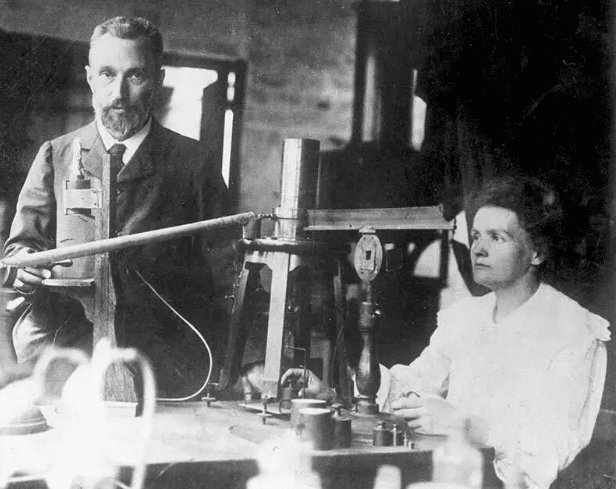
"This photo shows the Curies in their laboratory around 1904." (Fineartamerica 2021)
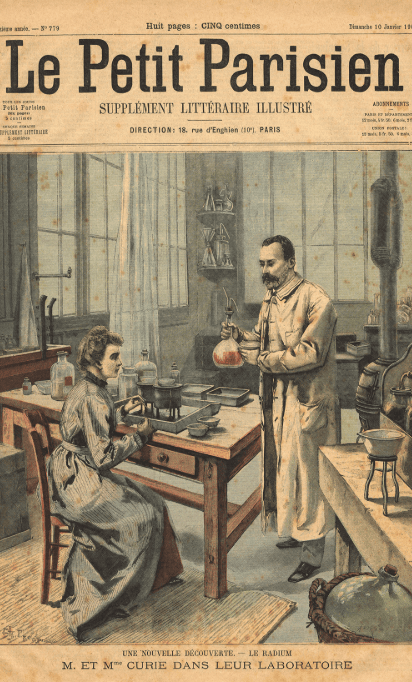
"Illustration of the Curies at work in their laboratory, circa 1904." (Blum 2016)
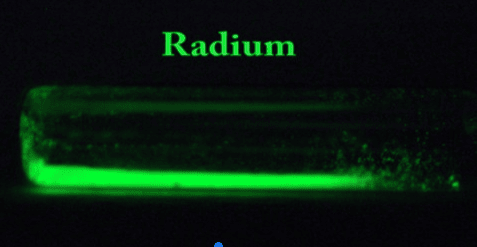
"Radium." (Assignment Point)
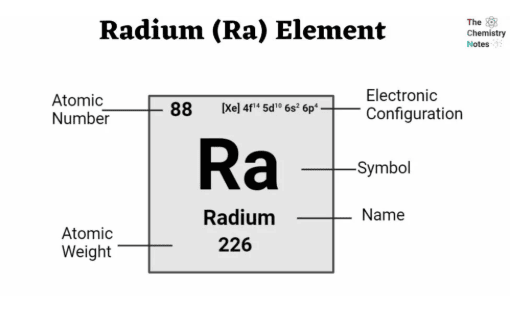
"Radium (Ra) Element." (Science Info 2023)
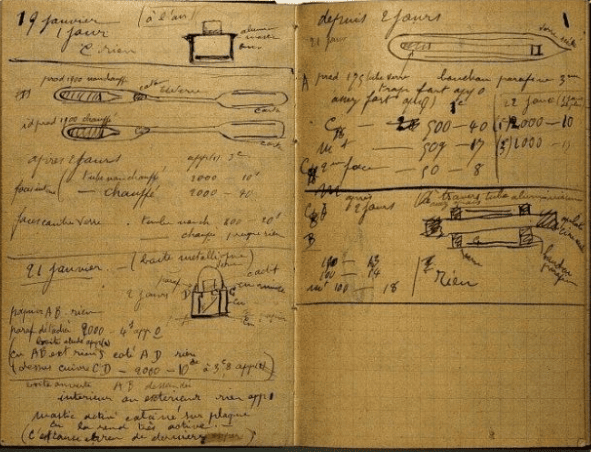
A highly radioactive journal, containing Marie’s research. (Valjak 2018)
"My beautiful Radium."
~ Marie Curie
(Moore 18)
"These gleamings seemed suspended in the darkness [and] stirred us with ever-new emotion and enchantment."
~ Marie Curie
(AHF 2017)
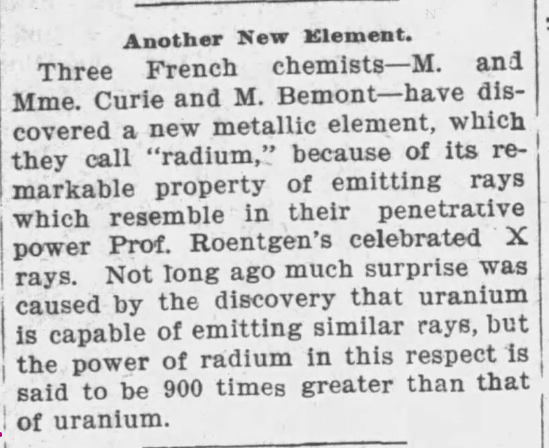
News report describing "radium" and its high radioactivity. (Kenosha News 1899)
Radium Opinions
Pierre Curie
"He would not care to trust himself in a room with a kilo of pure radium, as it would doubtless destroy his eyesight and burn all the skin off his body, and probably kill him." (Holmes 2010)
Marie Curie
"Curie, like other researchers and industrialists of the day, was unclear about the health effects of exposure to radioactivity." (American Institute of Physics)
Contemporary Scientists
"At the time, scientists didn’t know the dangers of radioactivity." (Feder)
"1901: Scientists learn that radium can destroy human tissue and tumors and begin using radium as a medicine." (Moore 349)
Contemporary Doctors
"By the 1920s, radium had been used for the treatment of cancer patients particularly in cases like skin cancer and other tumors which could be accessed easily at the surface. Since it was placed right next to or even inside the tumor, doctors thought it was going to take out the cancerous cells without harmful action on the normal cells. But soon enough, doctors realized that, like with anything new, use eventually brings harm, and so with radium, as much was done to the healthy cells as to the cancerous ones." (Radium)
Public
"Information on the side effects of radium, however, was unavailable to the public. Most people believed the effects of radium were all positive. That is what was reported in magazines and newspapers around the country." (National Library of Medicine 2017)
Press
"The popular press saw radium as a scientific miracle with enormous curative powers." (Kovarik & Neuzil 1996)